
Specialties / Vacuum insulated glass
A thinner path
to better insulation.
Vacuum insulated glass can deliver meaningful thermal performance in a remarkably slim profile—opening new possibilities where conventional insulating glass may be too thick, too heavy, or too visually disruptive.
Could it work for your project?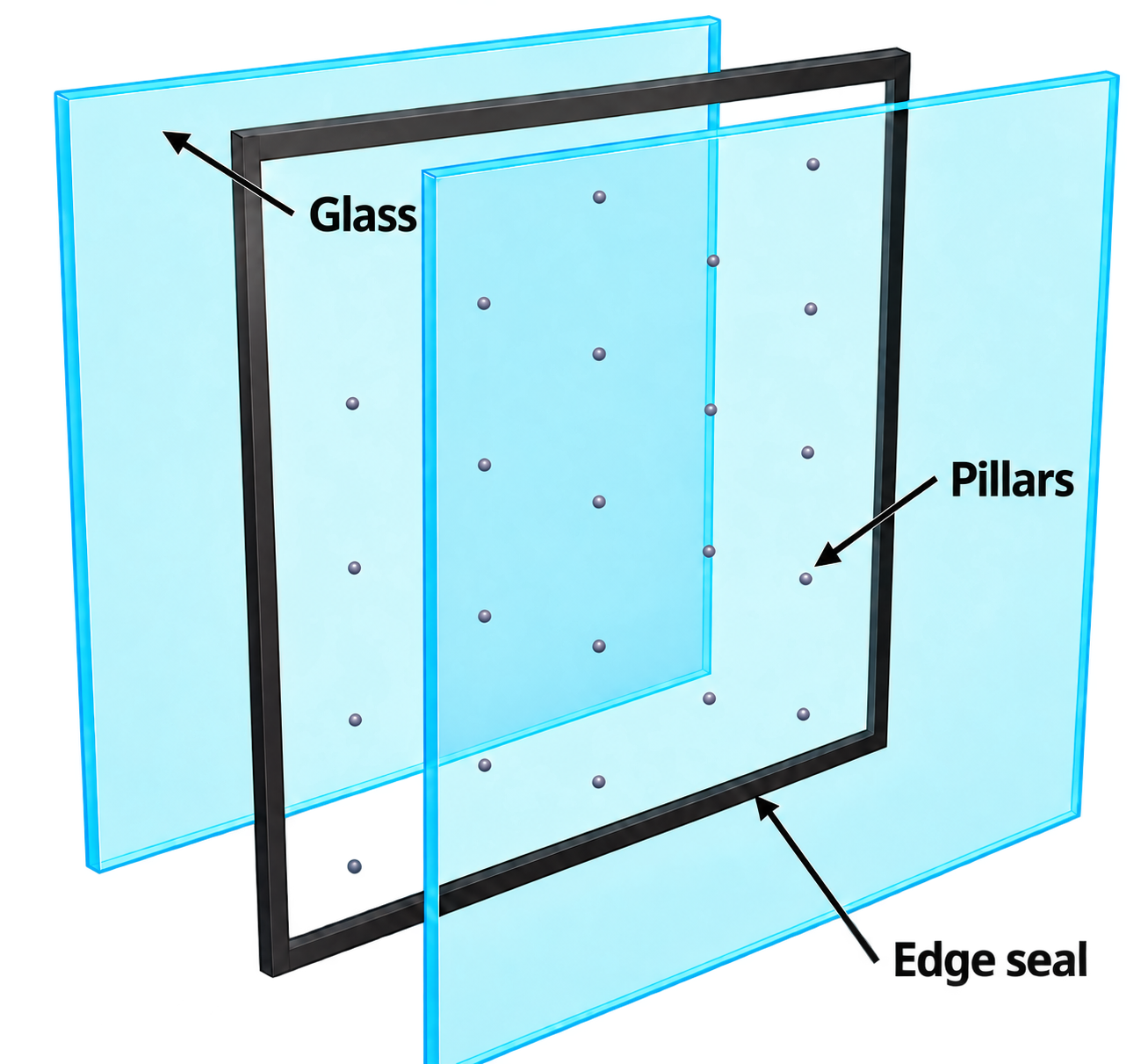
How it works
The space between
does the work.
Heat needs something to move through. A vacuum removes almost all of it.
Vacuum insulated glass places two panes of glass extremely close together. Tiny, discreet supports maintain that spacing while the air between the panes is removed and the perimeter is permanently sealed.
With very little gas in the cavity, heat transfer through conduction and convection is sharply reduced. The result is insulating performance from a unit that remains much thinner than conventional insulating glass.
Why the vacuum matters
Less room for heat
to move.
A conventional insulating glass unit relies on an air- or gas-filled space. VIG removes nearly all of that gas from a much thinner cavity.
The red and blue arrows make the difference visible: far less heat moves through the vacuum space. Low-e coatings further reduce radiative heat transfer, helping a slim unit deliver serious center-of-glass performance.

The detail that changes the view
No visible port.
No distracting plug.
A clean glass surface from edge to edge.
Many vacuum glass units have a visible evacuation port—the small sealed point where air was removed from the cavity. This port-free design eliminates that visual interruption, leaving nothing on the face of the glass to compete with the architecture.
warranty
Confidence beyond the detail
A forward-looking solution.
Backed for the long term.
A 15-year warranty provides added confidence when considering vacuum insulated glass for a new design, renovation, or historic application.
Start with the question
What could a thinner
glass unit make possible?
- Could existing sash or frame proportions remain?
- Could thermal performance improve without changing the character?
- Could a difficult retrofit become a workable detail?
You don’t need to know whether VIG is the answer before reaching out. Bring me the opening, the detail, or the performance question you’re working through.
Ask about your project